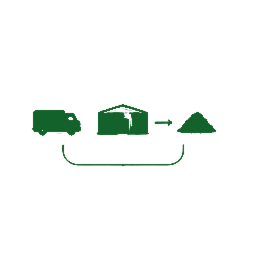
Material Quality
Clean separation and predictable feedstock determine the quality, cost, and credibility of every downstream outcome.
Lifecycle Organics works across organic recovery, composting, soil products, infrastructure, carbon accounting, and project delivery. The sections below add context to the same subjects covered across the site, showing how material, operations, land use, finance, and community participation connect in real programs.
Operating context
Collection, feedstock quality, biological processing, land use, climate accounting, and public participation all affect one another. The value of circular organics comes from those connections: clean material keeps operations stable, stable operations create usable products, and usable products make environmental and economic outcomes easier to measure.
System frame
Lifecycle Organics' main site introduces the work: municipal infrastructure, compost and soil amendments, fertilizer inputs, project development, carbon value, and implementation partnerships. The notes below add operating context to those same subjects, with a focus on how decisions affect program performance.
The same logic applies at different scales: a resort kitchen, a municipal collection route, a composting site, a farm amendment program, or an island-wide recovery platform all depend on the same chain of material quality, operational discipline, and measurable outcomes.
Clean separation and predictable feedstock determine the quality, cost, and credibility of every downstream outcome.
Composting is an engineered biological process, not simple disposal by another name.
Diversion, avoided methane, soil carbon, and ESG claims need clear boundaries and defensible data.
Infrastructure lasts when finance, governance, staffing, training, and public trust are built into the operating model.
Topic background
Each section expands on a subject already present in the Lifecycle Organics platform: what it means in practice, why it matters, and how it connects to the other workstreams.
A circular organics system begins by changing the role of organic material in the economy. Food scraps, landscape trimmings, agricultural residues, and other biodegradable streams are often treated as disposal liabilities because the system around them is built to move material away. Circular design asks a different question: where does this material still have biological, agronomic, climate, or economic value, and what infrastructure is needed to preserve that value? The strongest systems do not simply divert waste. They create an intentional pathway from source separation to processing, product development, land application, and measured outcomes.
Design around the loop.Recovery, processing, product use, and reporting need to be planned as connected stages rather than separate services.
Protect value early.Material loses value when contamination, poor routing, or unclear responsibility enters the system at the source.
Measure beyond tonnage.Diversion matters, but lasting value also includes soil performance, reduced hauling, avoided emissions, and local economic return.
The operational heart of organics recovery is feedstock control. A composting facility, fertilizer program, or carbon project cannot outperform the material it receives. That makes source separation, storage, collection frequency, route design, contamination control, and staff behavior more than logistics details; they are the quality-control system for the entire platform. Commercial kitchens, hotels, markets, households, farms, and municipal collection points all produce different material profiles, and each profile has to be matched to containers, training, service cadence, and processing capacity.
Feedstock is a specification.Moisture, contamination, particle size, volume patterns, and carbon-to-nitrogen balance shape the system before material reaches the site.
Operations set the economics.Collection routes, container turnover, labor time, and rejected loads affect cost as much as equipment or facility design.
Behavior is infrastructure.Training, signage, accountability, and feedback loops keep separation standards from degrading over time.
Composting is where recovered organics become a stable biological product. The process depends on managing oxygen, moisture, temperature, microbial activity, feedstock balance, and curing time so material is transformed rather than merely decomposed. When that process is controlled well, the output is more than a disposal endpoint. Finished compost can improve soil structure, water-holding capacity, nutrient cycling, microbial diversity, and resilience under stress. The strategic value of compost therefore depends on both process quality and the ability to match the finished product to real soil needs.
Process control creates trust.Temperature, aeration, moisture, and curing records turn compost from a rough output into a reliable soil product.
Soil response is context-specific.Compost performance depends on crop, climate, soil texture, application rate, and existing organic matter.
Quality assurance protects the market.Testing, maturity standards, and contamination controls are essential to maintain confidence among growers and land managers.
Circular organics systems only close when finished products return to land in ways that improve performance. Farms, orchards, nurseries, public landscapes, degraded slopes, and restoration sites each need different material specifications and application strategies. The practical question is not simply whether compost is beneficial, but where it delivers the highest value: improving water retention, rebuilding organic matter, reducing erosion, supporting crop nutrition, stabilizing disturbed land, or replacing imported inputs. This is where waste recovery becomes land management and regional resilience.
Application is a design decision.The same amendment can perform differently depending on soil condition, crop needs, slope, rainfall, and timing.
Local products reduce dependence.Turning local organic streams into local inputs can reduce reliance on imported soil amendments and synthetic nutrients.
Restoration needs measurable baselines.Soil tests, erosion risk, vegetation targets, and water behavior help define whether land is actually improving.
Organic waste recovery can create climate value by avoiding methane from landfill disposal, reducing transport burdens, improving soil carbon dynamics, and supporting lower-impact agricultural systems. But climate value is only useful when it is measured with credible boundaries, assumptions, and documentation. Carbon credits, ESG reporting, municipal climate claims, and corporate sustainability disclosures all require a clear chain of evidence. The opportunity is significant, but so is the need for discipline: programs must distinguish modeled potential from verified reductions, and voluntary claims from market-ready credits.
Boundaries come first.Baseline scenario, project activity, leakage, transport, processing, and product use need to be defined before claims are made.
MRV creates credibility.Measurement, reporting, and verification systems turn operating data into defensible environmental evidence.
Markets reward confidence.Additionality, permanence, methodology fit, and registry requirements affect whether climate outcomes can become tradable value.
The most technically sound circular system will fail if it is not buildable, financeable, governable, and understandable to the people who use it. Implementation brings together public-private partnerships, municipal decision-making, site planning, permitting, equipment, staffing, public training, reporting, and long-term accountability. Community engagement is not a communications add-on; it is part of the operating model because participation determines material quality and political durability. Strong programs are therefore designed around institutions as much as infrastructure.
Governance shapes performance.Clear roles, contracts, service standards, and reporting lines reduce ambiguity once a program is operating.
Finance follows risk.Capital planning depends on feedstock certainty, offtake confidence, regulatory context, and operating cost control.
Trust keeps the loop intact.Training, feedback, visible outcomes, and local benefit help communities keep participating after launch.
References & notes
Selected diagrams, case notes, and research references add detail to the subjects introduced across the site. They connect operating decisions to project data, soil outcomes, infrastructure design, and environmental claims.
Why clean organic collection determines feedstock value, processing reliability, and downstream credibility.
An annotated view of the biological phases, controls, and quality checkpoints inside composting.
How an integrated recovery system is being developed in a single island economy.
How characterization data informs feasibility, routing, contamination risk, and infrastructure sizing.
A systems map showing how material moves from source recovery through processing, product use, and measured outcomes.
The accounting behind diversion as a climate intervention — methods and assumptions.
A plain-language review of how amendments affect soil organic carbon over time.
How resorts and restaurants can structure back-of-house separation, collection, reporting, and local recovery.
New project diagrams, case material, and data references are added as work matures. Want updates?
Items marked “In progress” are in development and will be published as they're finalized. Verified results, assumptions, and methodologies are released as programs reach reporting milestones.
Common questions
Short answers to the questions partners ask most. For anything specific to your site or program, our team is glad to talk it through.
No. We operate as an integrated platform across recovery, processing, soil products, carbon accounting, infrastructure, and community implementation. Those areas work together: the output of one process becomes the input of the next.
The same subjects come up for municipalities, businesses, investors and developers, resorts and hospitality groups, restaurants and food-service operators, landowners, farms, commercial growers, nurseries, environmental organizations, and public-private partnership stakeholders.
Organic material is captured at the source, processed through controlled composting or related operations, and transformed into soil amendments and agricultural inputs. Those products restore land and support farming, while avoided landfill emissions and reduced hauling can create measurable climate value.
Yes. Programs are designed to serve public agencies, private operators, and land managers under one framework — frequently through public-private partnerships. Finance, governance, service standards, and community participation have to be designed together.
Diverting organics from landfill can avoid methane, and returning compost to soil can support long-term carbon and soil-health outcomes. When reductions are measured, reported, and verified under a recognized methodology, some outcomes may become tradable credits or defensible sustainability claims.
Work With Us
These topics reflect work we deliver in practice. Tell us about your municipality, business, or land — and we'll structure a program around the operating realities and outcomes you need to measure.